 24, Oct. 2026
Every week, importers ask Chinese wall panel manufacturers the same three questions: price, MOQ and lead time. And every month, some containers arrive with a problem those questions could never prevent. The boards are not broken. They are the wrong shade of grey.
Decorative panels are a visual product. A furniture panel supplier can ship sheets that are mechanically perfect — correct thickness, clean edges, intact packaging — and still hand you a container you cannot install, because two production batches sit side by side on the same wall and do not match. Broken boards show up in dock photos; color drift shows up only after installation, when the room is lit and the doors are hung.
This guide walks the import path: vetting decorative panel manufacturers in China, sampling, FOB and CIF quotes, T/T payments, QC inspection for panels, loading and claims.
Anyone searching pvc panel suppliers or melamine suppliers online meets a mix of real factories and trading companies, and a polished English website tells you nothing about which is which. Both can deliver; they carry different risks. A factory controls press line, raw board and schedule. A trader controls communication, consolidation and paperwork — but cannot fix your run at 10 p.m.
How to tell them apart on first contact:
● Ask for a live video walkthrough, not a brochure. See the hot press, raw-board storage and edge line in one continuous call. Pre-recorded footage is reusable by anyone; a live pan across the yard is hard to fake.
● Ask a technical question the salesperson should answer immediately: press temperature, board density range, or what happens when the decor paper batch changes. A factory engineer answers in seconds; a trader promises to check.
● Ask for the workshop address and business registration name and compare them. A trading name registered at a residential office is a trader — fine, just price the relationship accordingly.
| Factor | Factory direct | Trading company |
| MOQ per decor code | Higher; 200–500 sheets typical | Lower; can mix decors and categories |
| Price per sheet | Lower, fewer margins | Adds a service margin |
| Technical answers | Real-time, from the line | Relayed, slower |
| Mixed-category orders | Limited to own range | Strong; can combine boards, edge tape, profiles |
| Best fit | Program buyers, repeat decor codes | First containers, small mixed orders |
An honest trader consolidating a mixed first container saves you MOQ pain across three factories. The danger is the one pretending to own the line.
The approval sample is the only thing that defines "correct," so treat it as a contract exhibit. Ask for full-size or half-size sheets, not a 10 cm swatch card: texture repeats, grain direction and sheen only show at scale, and read differently under a phone camera than in a finished kitchen. Approve color under the lighting where the panels will actually be used.
Four measurable things belong on the approval record:
The single most valuable habit in this trade: seal two signed sample sets at approval — one with you, one with the supplier — held until the program is installed and accepted, marked with decor code, gloss and date. These are your retain samples. Without them, post-arrival color discussions are two people arguing from memory; with them, a third-party inspector holds production against an objective reference before the doors close. Batch numbers must appear on pack labels for the same reason — an untraceable claim cannot be quarantined. Buyers who write ΔE bands and retain-sample clauses into paperwork almost never have color claims.
Quotes arrive per sheet, but your fabrication cost is per square meter. Export panels run 1220 × 2440 mm — the metric 4×8 — at 2.977 m² per sheet; divide any sheet price by 2.977 before comparing offers. Then check thickness: an "18 mm" board pressed at 17.6 mm uses measurably less core than one at 18.0 mm, and two quotes 4% apart may simply be two different boards. Put nominal thickness plus a tolerance — e.g. 18 mm ± 0.2 mm — on the PO.
FOB and CIF split responsibilities differently, and confusing them is a classic first-importer error:
| Cost element | FOB (named Chinese port) | CIF (named destination port) |
| Ex-works panel price | Seller | Seller |
| Inland trucking + export clearance | Seller | Seller |
| Ocean freight | Buyer | Seller (prepaid) |
| Minimum marine insurance | Buyer arrange | Seller arranges minimum cover |
| Import duty, destination port fees, delivery to door | Buyer | Buyer |
Neither term covers import duties, destination handling or inland delivery. Confirm full landed cost with your local customs broker before you commit — the broker is the authoritative source for duty rates, documentation and emission or import requirements at your port.
The standard rhythm is T/T 30% deposit, 70% against a copy of the bill of lading. The deposit secures raw board and line time; the balance is wired when documents prove the goods are on the water. A deposit is commercial commitment, not escrow — a wire is only as safe as the supplier's interest in repeat business, which is why Steps 1 and 2 come first. For larger first orders, a sight L/C substitutes bank discipline for trust: documents trigger payment, at the cost of fees and paperwork. Smaller orders run on a higher deposit, balance before loading; open-account terms arrive only after a relationship exists.
MOQ is usually one 20 GP per mixed container, or roughly 200–500 sheets per decor code for custom production; standard decors can be mixed. The contract should list decor codes, substrate and density, thickness plus tolerance, sheet size in millimeters, emission grade (ENF / E0 / E1, with the actual test report supplied before booking), gloss and ΔE bands, edge treatment, packaging and a loading plan.
From deposit to sailing, plan four to six weeks: confirmation and substrate allocation (3–7 days), pressing and edge work (15–25 days), container booking about a week before cargo is ready.
Three inspection moments catch almost everything:
● Before pressing: confirm substrate and decor paper codes match the PO; verify premium imported decor paper against the approved reference.
● Mid-run: inspect the first 50–100 pressed sheets, where color and gloss drift are cheapest to fix.
● Final pre-loading: random inspection per standard AQL tables — count, thickness at four corners, surface defects, color and gloss against the retain sample, edges, packaging.
Send your own QC or a third party such as SGS or Intertek at your cost, and write inspection timing and AQL levels into the contract so the run is staged for inspection, not presented sealed. If emission grade matters, request the ENF/E0/E1 report for the exact batch here — never wait for arrival, and never accept fabricated certificates.
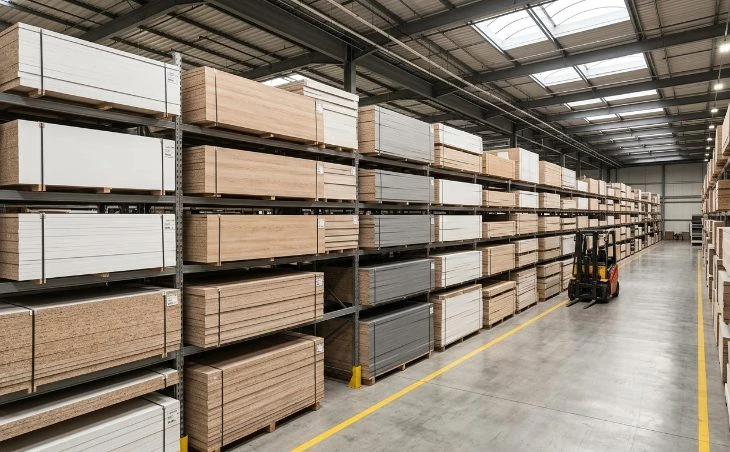
Panels typically ship in packs of 40–80 sheets on plywood pallets, with hardboard top and bottom, corner protectors on all eight corners, and PE moisture film (plus desiccant for humid lanes). Bulk loading gains roughly 8–12% more sheets but raises unload damage risk — palletized is the safer default.
When you container load panels, payload, not volume, is usually the limit. A 20 GP allows roughly 18–22 t depending on carrier and route; a 40HQ roughly 22–27 t, subject to road weight limits at both ends. Typical 18 mm melamine-faced particle board runs about 33–36 kg per sheet:
| Container | Palletized load, 18 mm board | What limits it |
| 20 GP | ≈ 300–450 sheets (≈ 18–20 t) | Payload |
| 40HQ | ≈ 600–750 sheets (≈ 24–27 t) | Payload + pack layout |
| 40HQ, 9–12 mm board | Higher sheet count | Cube/volume first |
| 40HQ, 25 mm board | Lower sheet count | Weight first |
These are planning figures, not guarantees. Ask the furniture panel supplier for a signed loading plan — pack count, sheets per pack, gross and net weight — and verify it against container payload and your delivery truck's road limit.
After sailing, the supplier releases the bill of lading against the balance. The clearance file normally includes commercial invoice, packing list, bill of lading and certificate of origin; solid-wood packing needs fumigation or heat-treatment declarations (plywood pallets are usually exempt, but rules differ). Duties, inspections and emission documentation are destination-specific — confirm the checklist with your broker before booking.
Claims windows are short — commonly seven days from unloading, always before cutting. A valid claim needs batch numbers, pack labels, wide and close photos, and measurements against the retain sample. Claims generally cover production defects — delamination, wrong decor, thickness outside tolerance, color drift beyond the agreed ΔE — not wet-storage damage, machining errors or installed product. The leverage exists before the container seals; afterward you negotiate from photos across time zones.
Importing decorative panels is not hard; it is visual. Vet the supplier type honestly, approve full-size samples under real light, lock ΔE and gloss bands on paper, seal retain samples, inspect at three nodes, and load against a signed weight-and-count plan. At SinoPanels, retain-sample photos and batch tags are sealed with the inspection record before every container leaves — because the cheapest claim is the one that never boards the ship.
If you are specifying the panels themselves rather than the trade path, our melamine board buyer's guide covers grade selection, the kitchen cabinet panel guide walks through finish choices by cabinet zone, and the melamine faced chipboard guide explains the substrate inside most container programs.
Planning a first container from China? Shortlist two or three factories, run a live video audit, and ask each for the same five artifacts: full-size sample, signed retain set, thickness tolerance, batch-label policy and a written loading plan. The responses will rank your suppliers faster than any spreadsheet of prices.