 29, Sep. 2026
Ask ten cabinetmakers what the best plywood for cabinets is and you will get ten confident answers — followed by a bill of materials showing that half the cabinet is not plywood at all. The question hides an assumption that no longer matches how most kitchens are built.
A kitchen cabinet is not one product. It is a carcass, a set of visible fronts, edge details and hardware interfaces, sitting in one of the harshest environments in a home: heat, steam, grease, splashes and thousands of door cycles. Each of those components has a different job, so each should carry a different panel specification. This guide walks through the decision in the order it actually happens — starting with a distinction buyers blur constantly.
Every decorative panel is a facing laminated onto a structural core, and the two answer different questions.
The facing decides how the cabinet looks and how its visible surfaces survive cleaning: PET film, melamine resin, acrylic, veneer or laminate sheets. The core decides weight, screw-holding, edge behavior and moisture response: cabinet grade plywood, MDF, particle board or fine-strand board.
In the US retail market, "cabinet grade plywood" usually means a sanded, veneer-faced panel — the kind bought in 4×8 sheets at a lumber yard and finished in the shop. In export flat-panel programs, the typical construction is different: a factory-faced board (melamine or PET) on MDF or particle board, cut and edged on automated lines. Neither is wrong. They are different production systems, and confusing them is why buyers sometimes spec American plywood grades into a container program that never planned to use them.
Plywood is the benchmark structural panel for good reason. Cross-laminated veneers give it the best screw-holding of the common cores, and screws can be removed and re-driven with little loss of grip. It tolerates ambient humidity and occasional splashes better than fiber or particle boards, and it is light for its strength.
That makes plywood the right call in specific places:
What plywood does not automatically deliver is a finished face. Even the best hardwood plywood for cabinets needs sealing, veneer edge treatment or a separate door program — and good veneer-faced plywood has become genuinely expensive. Our full substrate guide breaks down the numbers; the short version is that specifying plywood everywhere can add 40–80% per sheet over a good faced board, in places where nobody will ever see or benefit from it.
Here is the view you will rarely see in a retail plywood article: the majority of production kitchens worldwide are built on factory-faced MDF and particle board, and they are not built that way only because it is cheap.
Faced boards arrive finished. The facing — a cured melamine resin surface or a PET film — is applied under factory pressure across the whole sheet, consistent in color, gloss and texture. There is no in-shop finishing schedule, no spray booth, no drying time. Cut, edge, drill, assemble.
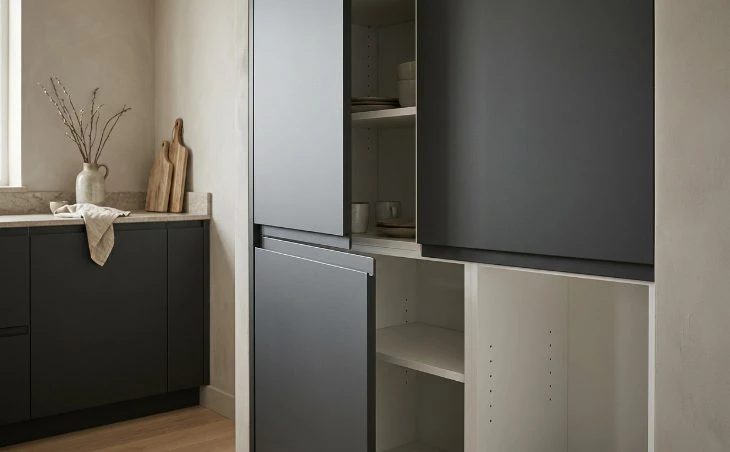
They are flat and stay flat. MDF in particular gives a perfectly uniform bed for thin films, which is why slab doors at the premium end — the near-zero-gloss ultra matte fronts in modern showrooms — are overwhelmingly PET-faced MDF. Nothing telegraphs through the film under raking light.
They are dimensionally predictable. Calibrated import boards hold tight thickness tolerances, which matters when a line is producing hundreds of cabinet boxes that must stack square.
The honest weaknesses are real and should be designed around rather than ignored: particle board screws strip if over-tightened, so cam hardware and correct torque matter; fiber and particle cores swell if they sit in water, which is why wet-zone boxes belong on plywood or MR-grade cores; cut edges need proper banding, not as an aesthetic extra but as moisture protection.
This is the practical specification most buyers are actually looking for.
| Cabinet zone | Typical specification | Why |
| Visible doors & drawer fronts | PET- or premium melamine-faced MDF | Flatness, color depth, anti-fingerprint options |
| Carcass sides, tops, bottoms | Melamine-faced particle board or MDF | Finished surface, cost, square assembly |
| Sink base / wet zone | Plywood or MR-grade core | Humidity and splash tolerance |
| Shelves | 18 mm faced board; plywood for long spans | Sag resistance depends on thickness, not just species |
| Backs | Thin faced panels | Rigidity and a wipeable interior |
| Visible end panels | Door-matching facing | The side of a cabinet is a display surface |
Notice what this means for the original question. "What is the best plywood for cabinets?" is the wrong starting point. The right question is "which zones need plywood's properties, and where am I paying for performance nobody experiences?"
The term causes genuine confusion in international trade, because laminate refers to two related but different constructions:
Both are legitimate, and PET film sits alongside them as the premium facing tier — softer matte, more consistent anti-fingerprint performance, slightly higher cost. When buyers search for kitchen cabinet laminate or cabinet laminate sheets, they are usually solving for the facing decision: the look and wear layer. The core decision underneath it stays open.
A note on appearance claims: woodgrain melamine at the current generation — synchronized embossing, where the printed grain and the pressed texture align — is difficult to distinguish from veneer at arm's length, and it does not move with seasonal humidity. Calling it "fake wood" badly undersells the technology.
One question that surfaces in every material discussion is shelf deflection — and buyers often chase it with the wrong variable. A loaded shelf bends according to its modulus of elasticity, its thickness and its span. Of those, thickness is the lever with the most dramatic effect: doubling thickness roughly quadruples stiffness, because the relevant term is the cube of thickness.
The practical consequence: a 38 mm particle board shelf will outperform an 18 mm plywood shelf over the same span, at lower cost. Upgrading species while keeping thin stock is an expensive way to solve the wrong problem. For standard 600 mm cabinet bays, 18 mm faced board handles normal loads; long spans over 800 mm, or shelves carrying dense loads like books and crockery, should move to 25 mm or gain a mid-support rather than a pricier species.
This is the kind of specification detail that separates a kitchen program designed on physics from one designed on reputation.
On a factory-faced board, the cut edge is the one place the core is exposed. Edge banding does three jobs: it finishes the visual, it seals the core from moisture, and it protects the facing from chipping at the corner.
The spec to care about is matching — same decor, same gloss — and thickness appropriate to use: 0.8–1 mm for standard carcass edges, 2 mm for visible front edges and high-wear commercial work. For the cleanest look, laser-applied functional-layer banding produces a zero-joint seam with no glue line; on a matte dark door under a showroom spotlight, a glue line is the first thing the eye finds.
Instead of one material for the whole kitchen, put the decisions on the PO separately:
At SinoPanels, the kitchen programs we supply tend to run on PET-faced MDF fronts, melamine-faced board carcasses, and plywood or MR-grade cores only in sink bases — because specifying the core by what each zone actually does controls cost without giving up performance in the places a customer can see or feel.
Plywood is not being displaced by cheaper boards so much as redeployed to where its properties matter. The modern kitchen is a hybrid: plywood where moisture and joinery demand it, faced MDF and particle board where a factory-finished surface and predictable flatness do the job better for less money. Buyers who stop asking for one best material and start specifying by zone are the ones whose kitchens arrive square, survive the wet corner, and still look sharp after the warranty period.