 19, Oct. 2026
Walk through a furniture plant and the board under the saw is usually the one least discussed in the showroom: MDF. Consumers see "cheap compressed sawdust." Plant managers know it as the most predictable substrate on the floor — the core behind nearly every painted profile door, every high-gloss and ultra-matte front, and most mouldings a cabinet line touches.
So what is MDF? The mdf meaning is Medium Density Fiberboard — a dry-process fiberboard made by reducing wood to individual fibers, blending them with resin, and re-forming them into a homogeneous panel. It is not plywood (cross-laminated veneers) and not particle board or chipboard (glued flakes). This guide covers how mdf panels are actually made, the physical structure that decides machining quality, the property numbers worth putting on a purchase order, and the difference between standard, moisture-resistant and fire-rated MDF.
Formal definitions live in ANSI A208.2 in North America (which classifies panels by density and bond performance) and in European EN 622 series boards, with ASTM D1037 providing the test methods for strength, moisture and dimensional checks. Chinese production typically references GB/T 11718.
The numbers buyers actually use:
MDF has been produced commercially since the 1960s, and its rise solved one factory problem: a board with no grain direction, no knots, no veneer voids, and near-identical properties across every square metre — a router bit sees the same material on Monday and Friday.
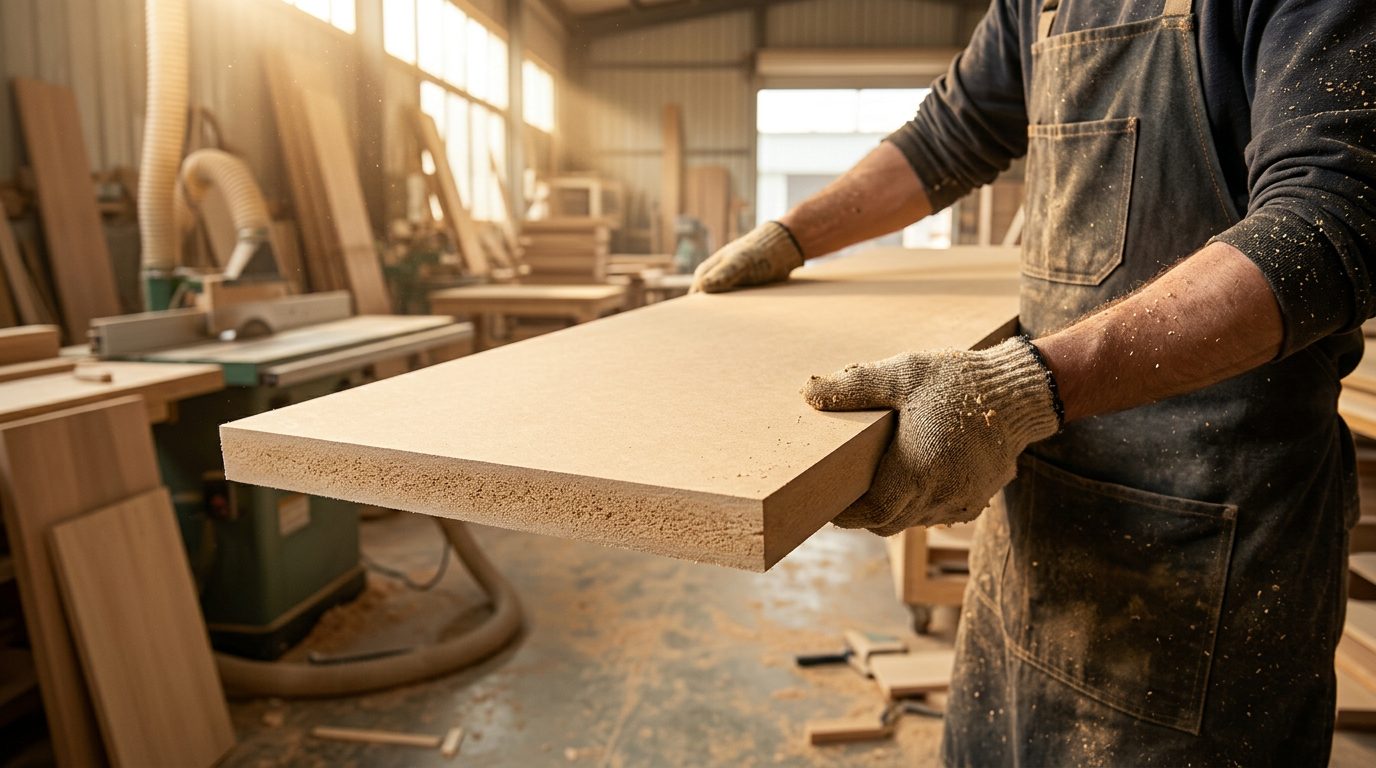
Understanding mdf properties starts on the production line, because every later limitation — edge absorption, the profile quality, the weight — is created in these six steps.
Nothing in this process produces sawdust glued flat, which is the consumer myth. The fibers retain their structural identity; the panel is a bonded fiber network, and the way that network is distributed through the thickness is the most important fact about MDF most buyers never learn.
Here is the counterintuitive part. MDF is not uniform density from face to face. It cannot be.
During pressing, the surfaces touch the hot platens first. Heat and moisture plasticize the surface fibers, and the compaction wave drives a dense zone just under each face. At the core, temperature lags and pressure is partly absorbed by the mat, so density peaks roughly 0.5–1.5 mm under each surface and drops toward the centre. A typical 18 mm furniture board might measure 850–950 kg/m³ at the density peaks, against 600–700 kg/m³ in the core — even though the board's average density is 730 kg/m³.
That hard-skin, soft-core profile explains a great deal:
When a supplier quotes average mdf density alone, you buy an average that hides the profile. Tight mills control the shape of that curve, not just its mean.
Typical values for an 18 mm furniture-grade board; exact numbers are grade- and mill-dependent, so ask for the actual test report rather than brochure copy.
| Property | Typical 18 mm furniture MDF | Test basis |
| Average density | 720–760 kg/m³ | EN 323 / ASTM D1037 |
| Internal bond (IB) | 0.55–0.80 MPa | EN 319 |
| Modulus of rupture (MOR) | 26–35 MPa | EN 312 / ASTM D1037 |
| Modulus of elasticity (MOE) | 2,500–3,500 MPa | EN 312 |
| Thickness swell (24 h) | 8–12% | EN 317 |
| Formaldehyde emission | ENF / E0 / E1 | EN 13986 / EN 16516 |
| Thickness tolerance (sanded) | ±0.2–0.3 mm | EN 324 / mill standard |
Internal bond and thickness swell are the two numbers to negotiate hardest. A board that passes a 720 kg/m³ density spec but delivers 0.45 MPa internal bond will delaminate at the first deep profile, while a low swell value predicts behavior at a cold, damp loading dock.
The case for MDF in mdf furniture is almost entirely engineering:
The limits are equally clear:
Consumers underestimate MDF because they only see painted doors. Factories depend on it for the same reason — the material disappears into the finish.
"Mdf panels" are a family, not a single grade. Specifying the type on the order prevents the expensive habit of shipping premium board into dry locations and standard board into damp ones.
| Type | Core change | Where it belongs |
| Standard interior MDF | Urea-formaldehyde or NAF binder | Bedrooms, living rooms, office furniture, dry retail |
| MR (moisture resistant) | Moisture-resistant resin system, often green-tinted | Bathrooms, kitchens, humid loading areas — not wet zones |
| HMR (high moisture resistant) | Higher wax/resin loading, often MDI | Coastal and tropical humidity, sink-adjacent cabinets |
| Fire-rated / FR MDF | Fire-retardant additives, tested panels | Contract, hospitality, public interiors per local code |
| Lightweight MDF | Lower-density fibers, 550–630 kg/m³ | Wall units, high doors, labor-sensitive assembly |
| High-density MDF | 800–880 kg/m³ | Router-heavy profiles, flooring underlay, mouldings |
| Ultrathin MDF | 2.5–4 mm | Drawer bottoms, tambour doors, curved backs |
MR is the most mis-sold grade in the family. It delays swelling under raised humidity; it does not make mdf board waterproof. For genuine fire rated mdf, specify the destination market's test target — such as EN 13501-1 class B-s1,d0 in Europe or ASTM E84 Class B in the US — and require current test reports from the supplier. FR additives slightly darken the fibers and shorten saw blade intervals.
Against melamine faced chipboard, MDF gives the cleaner edge and flatter face for visible, painted or film-faced parts; particle board is lighter, cheaper and perfectly adequate for carcasses and shelving when correctly banded. Most sensible programs use both. Against plywood, MDF loses on moisture tolerance and screw reusability but wins decisively on profile quality, face flatness and price for paint-grade doors — plywood belongs in sink bases and high-humidity structural parts, MDF everywhere a finish is applied.
A useful order carries eight fields: type and standard (ANSI A208.2/EN 622 class), average mdf density with an acceptable band, internal bond minimum, thickness swell limit, emission class ENF/E0/E1, exact format in millimetres, sanded thickness tolerance, and intended profile depth — deep profiles demand a wider density peak.
In one SinoPanels-supplied painted-door program, the buyer originally wrote simply "18 mm MDF." After profiling fuzz appeared on the second container, the spec was tightened to 740–760 kg/m³ average density, IB above 0.65 MPa, ENF emission, 18.0 ±0.2 mm, with a 0.5 mm maximum sanding allowance. The fuzz complaints disappeared within one batch — the mill already made that board; the order had simply described it loosely.
MDF rewards precision and punishes vagueness. Request samples from two or three density bands, rout your deepest profile on each, and take the edge absorption test seriously before booking a container. For melamine board ordering and the full kitchen cabinet program material list, the linked guides pick up here.