 29, Sep. 2026
Walk through cabinet showrooms in Milan, Munich or Seoul and the majority of slab doors sit at the low-gloss end of the spectrum. Matte finishes stopped being a trend around five years ago. They are now the default surface in mid-to-premium furniture programs, which is why every supplier offers something called "ultra matte" or "super matte" — and why the labels have become almost meaningless.
Two panels sold under similar names can differ in gloss level, fingerprint behavior, scratch response and film construction. This guide explains what actually makes a panel ultra matte, where the technology comes from, and what to write on your purchase order instead of trusting the adjective.
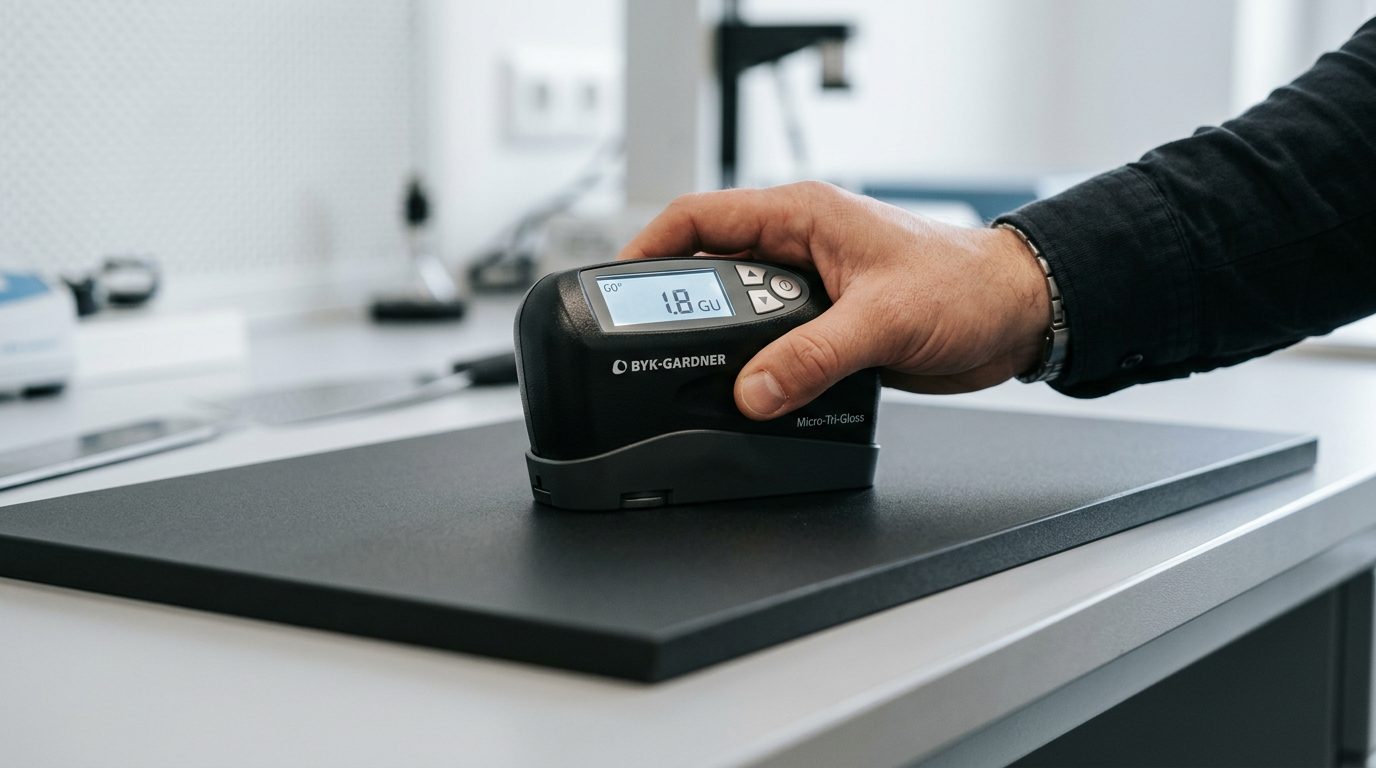
Surface gloss is measured with a glossmeter in gloss units (GU), most commonly at a 60-degree angle. The reading is objective, and the furniture industry groups finishes roughly like this:
表格
| Finish type | Typical gloss (60°) |
|---|---|
| Mirror / high gloss | 70–95+ GU |
| Semi-gloss | 30–60 GU |
| Standard matte | 10–20 GU |
| Lowest-gloss matte (marketed as ultra or super matte) | Under 8 GU, often 2–5 GU |
In day-to-day trade usage, "ultra matte" and "super matte" describe the same end of this scale, and suppliers use them almost interchangeably; some also use "ultra" for their lowest-gloss line and "super" for the step above it.
The important point for buyers: neither name is a standardized grade. One factory's ultra matte is another factory's standard matte, and in side-by-side display areas a difference of 3–4 GU is clearly visible, especially on dark colors. Reputable manufacturers can tell you the measured GU value of their panels. If the only answer is "very matte," you are buying marketing language rather than a specification.
You will also see both spellings — matt and matte. Both describe the same surface; matt is the common trade spelling in the UK and Commonwealth markets, matte in the US. Search behavior splits the same way, which is worth knowing when you label products and export catalogs for different regions.
To understand the finish, it helps to separate the facing from the core.
A pet panel carries a facing of polyester film laminated onto an engineered wood core — usually MDF or particle board. The film is thin (the decorative facing is typically a fraction of a millimetre), but it is a multi-layer product. The visible top layer is PET, formulated and processed for the surface effect. The matte look is created during film production: the film is cast or calendared against precision matte rollers or belts, and a hardened top coat locks the low-reflection texture in place. Beneath the decorative layer sits a functional backing layer engineered for adhesion to the core — and, in laser-grade constructions, for laser edge banding, where the functional polymer melts under the laser into a zero-joint seam.
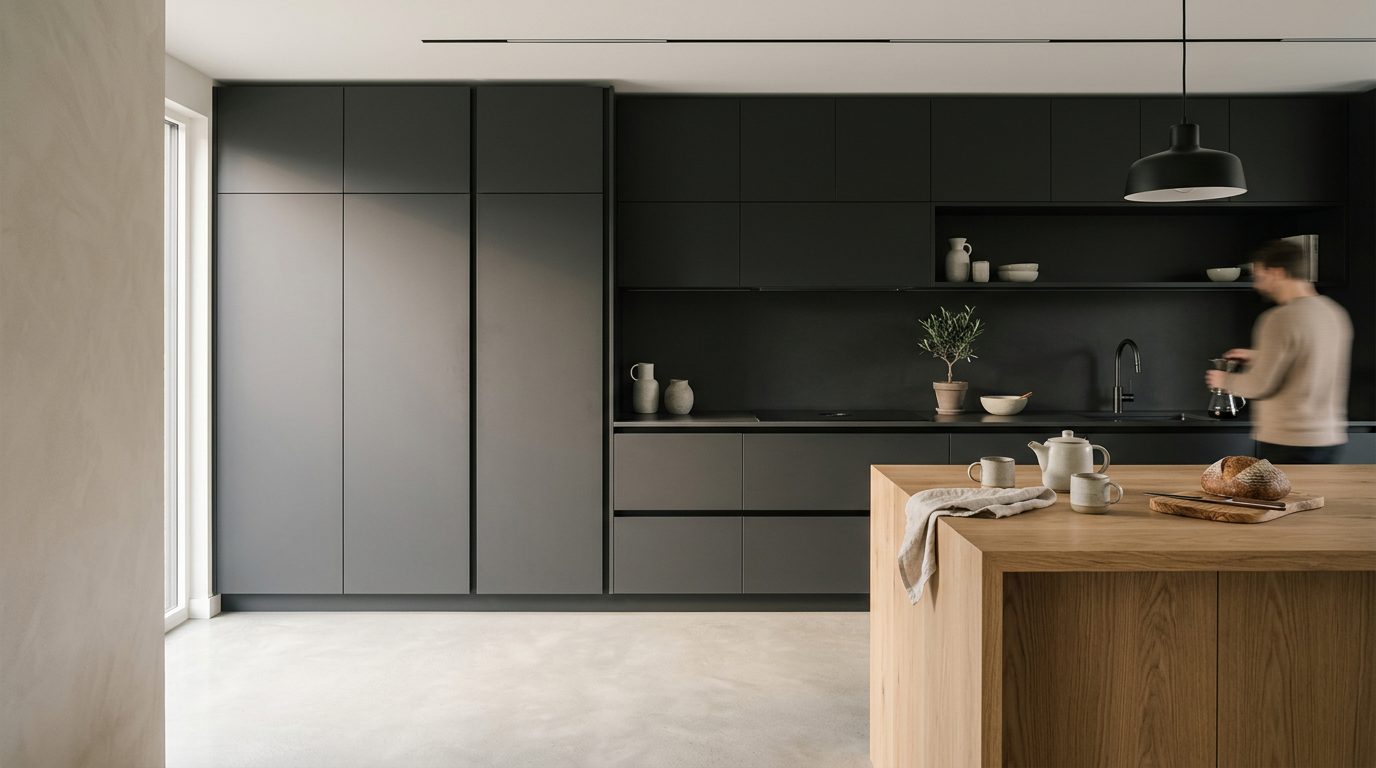
That construction is what separates PET panels from a conventional laminate board. On a melamine laminate board, decor paper impregnated with melamine resin is pressed directly onto the substrate under heat; the cured resin itself becomes the wear surface. PET adds a thermoplastic film on top, which is why PET generally offers a softer, deeper matte and more consistent anti-fingerprint behavior, while melamine remains the more economical choice for large-volume carcass and rental programs.
As for the core, matt mdf is the common pairing for premium matte doors for a practical reason. MDF's fine, uniform fiber structure gives the film a perfectly flat bed, so nothing telegraphs through under raking light. Particle board closes the price gap for value programs, and fine-strand faced boards are increasingly specified where cost per sheet matters. The choice of substrate is a separate engineering decision from the finish.
Here is the most commonly confused point in the category. A fingerprint is a deposit of water, salts and sebum — skin oil. Whether that deposit is visible depends on two different things: how the surface scatters light, and how the oil interacts with it.
A textured matte surface scatters reflected light, which hides a great deal. But untreated, oil does not sit on top of the texture; it wicks into the microscopic valleys of the surface, wetting them and changing the way they scatter light. That is why some cheap matte panels mark immediately: the matte hides scratches beautifully, then every finger press leaves a visible sheen.
A genuine anti-fingerprint matte adds a separate technology — a thin oleophobic (oil-repelling) hard coat that raises the contact angle of the surface. Instead of wetting into the texture, sebum beads on top and wipes away with a dry or lightly dampened cloth. This is chemistry applied over the matte texture, and it is worth repeating: the two properties are independent. A panel can be ultra matte without being anti-fingerprint, and anti-fingerprint coatings exist on higher-gloss surfaces too.
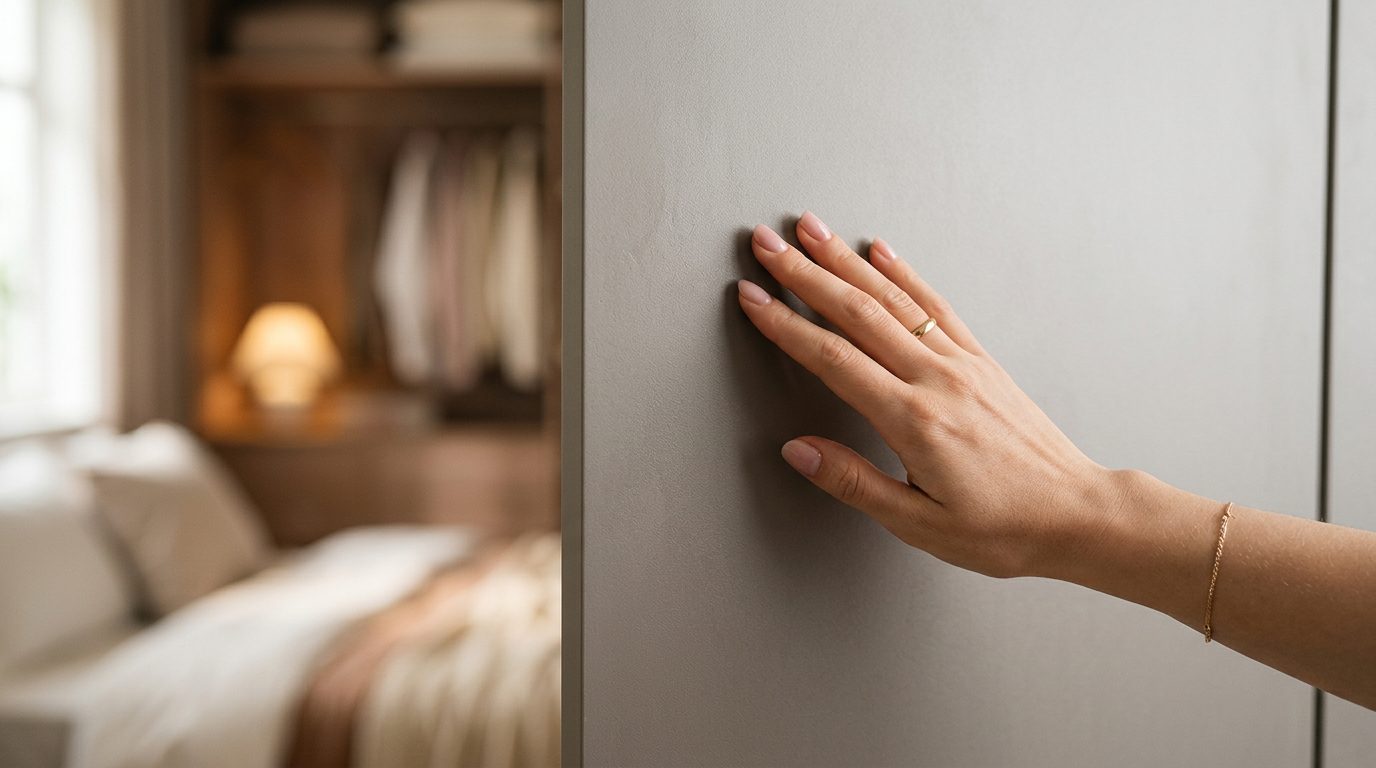
Soft-touch finishes go a step further by blending elastomeric components into the coating for the velvety, warm feel popular on bedroom furniture. The trade-off is cost and, sometimes, marking susceptibility — soft-touch surfaces benefit most from the oleophobic layer and from careful user habits.
No surface is free of trade-offs, and matte is sold with a few myths attached.
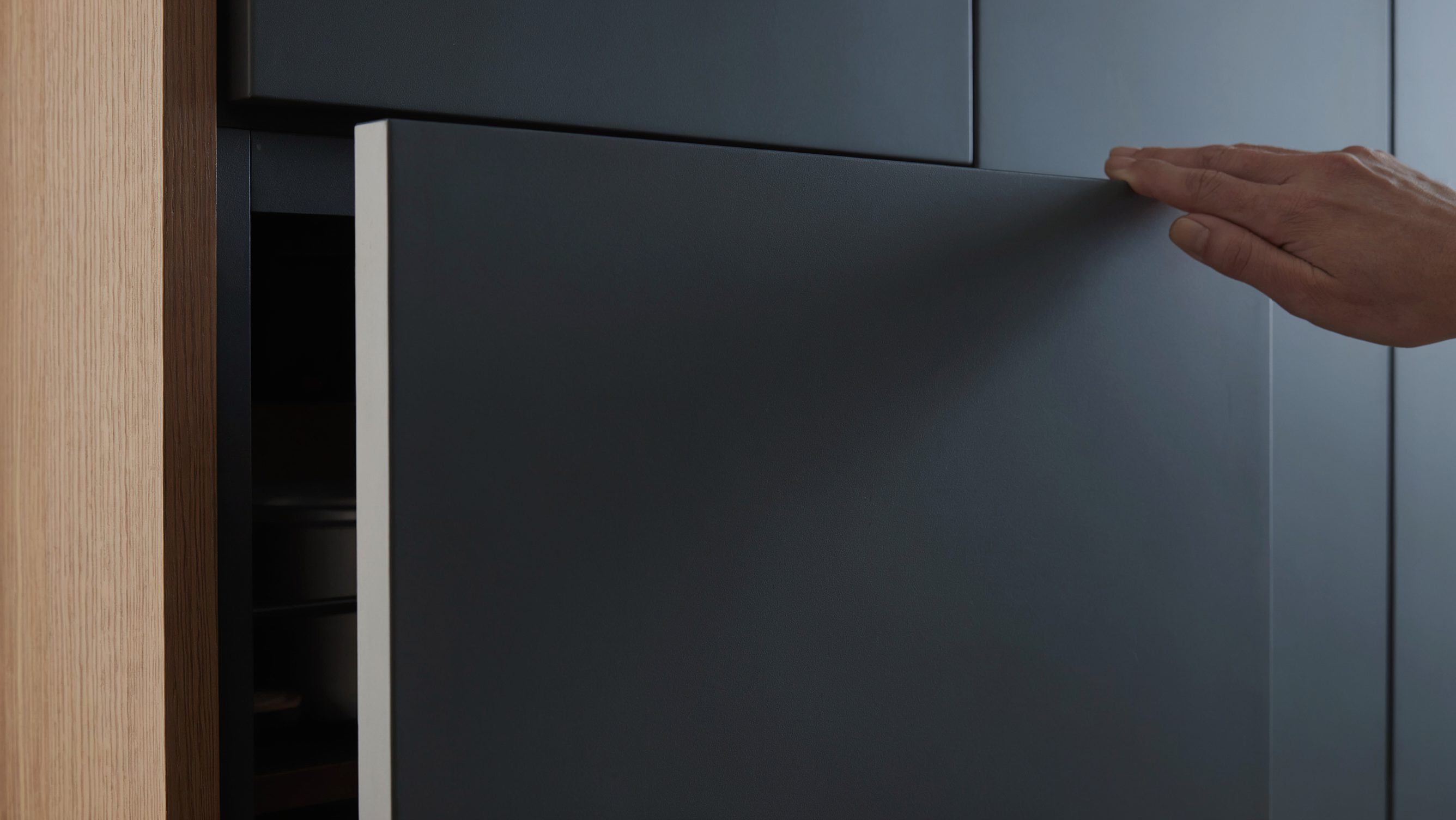
Micro-scratches and burnishing. Matte hides fine abrasion better than gloss — until the texture itself gets polished. Repeated rubbing in one spot, or a grit trapped under a cleaning cloth, compresses the micro-texture and leaves a smooth track that catches light. On dark panels these burnish marks are difficult to hide, and wax-based touch-up pens tend to make them worse by adding shine.
Cleaning discipline. Abrasive sponges, strong solvents and cream cleansers are the three things that damage matte coatings fastest. The correct method is lukewarm water, a clean microfiber cloth, and immediate drying so water does not evaporate into mineral spots. Steam cleaners should be kept away from edges.
Batch consistency. Low gloss values have tight tolerances. Panels from different production batches can read as slightly different shades on a long bank of doors, so door sets should be cut from the same batch and the agreed GU tolerance written into the order.
Photography and display. The same property that makes matte elegant in person — diffuse reflection — makes it hard to photograph, and suppliers' sample chips sometimes look lighter than full sheets under showroom lighting. Approve colors from large samples under the end-use lighting.
Buyers sometimes over-specify matte across an entire program, which quietly inflates cost where the finish earns nothing. The decision map is simpler than catalogues make it look:
A quick note on performance claims you can verify yourself when samples arrive: press a clean, slightly oily thumb onto the panel and leave it for thirty seconds. A properly treated surface lets the mark disappear after a light wipe with a dry cloth. Drag a clean microfiber cloth across the same area repeatedly — a coating that burnishes easily is a coating that will not survive household cleaning. Neither test replaces lab data, but both separate real anti-fingerprint panels from ones that are merely dull.
Instead of "ultra matte," specify the panel as separate, testable line items:
When customers request ultra matte from SinoPanels, we treat gloss value, anti-fingerprint performance and substrate grade as three separate line items rather than one marketing label — because the difference between a door that marks on day one and one that still looks clean after two years is almost always in those specs, not in the name on the sample.
Ultra matte is no longer a selling point on its own. Every catalogue has one — sometimes two, under different names. The differentiation has moved to measurable things: the actual gloss reading, whether oil beads or wets in, how the film bonds to the core, and whether production batches stay consistent. Asking for those numbers before the first container is the difference between buying a trend and buying a surface program your customers will not send back.
A: You should specify the gloss value measured in gloss units (GU), anti-fingerprint performance details, facing construction, substrate material and grade, edge banding match, and batch policy to ensure consistency.
A: Request the measured GU value for gloss, ask about the anti-fingerprint testing methods, and compare the thickness of the PET film used on the panels to assess quality and consistency.
A: It depends on the anti-fingerprint performance of the specific panels; ensure you specify panels with an oleophobic hard coat, as this feature helps repel oils and maintains the matte finish.
A: Ultra matte finishes reduce visual noise, absorb ambient light, create a calmer color appearance, and support handleless design, making them ideal for modern kitchens and contemporary furniture.
A: Yes, while ultra matte panels hide scratches well, they can develop micro-scratches with repeated friction, require careful cleaning methods, and may show variability in color between different production batches.