 14, Oct. 2026
Two containers of "BB/CC, 18 mm, 4×8 plywood" can leave the same port and deliver two different materials. One measures 17.6 mm in the middle of the sheet, with patched faces acceptable only under opaque lamination. The other reads 18.1 mm, with faces clean enough for a clear varnish. The purchase description was identical. The specification was not.
Plywood sizes, plywood thickness and plywood grades are three separate variables, and the habit of collapsing them into one shorthand line — "4×8, 18 mm, BB/CC" — sits behind a large share of factory claims. This reference treats them separately: the metric dimensions behind the imperial labels, the tolerance that decides whether your edgebander runs or jams, and the grade systems used in America, Europe and Chinese export production.
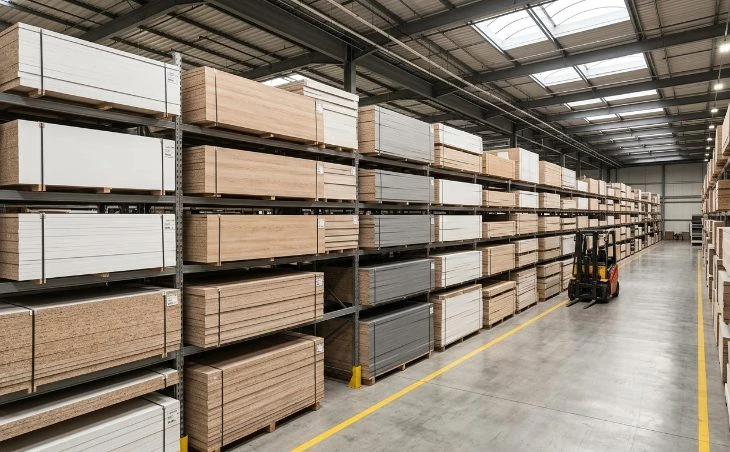
In North America, PS 1-19 structural and decorative panels are built around a nominal 48 × 96 inch sheet — 1219.2 × 2438.4 mm. Walk into almost any panel mill outside the United States, however, and the press line runs 1220 × 2440 mm — about 48.03 × 96.06 inches. That is the world's de facto standard 4x8 plywood sheet, and it is 0.8 mm wider and 1.6 mm longer than the American nominal.
For a distributor sawing rough components, the gap is invisible. For a cabinet line engineered around 48-inch modular openings, or a nesting program written for 2438 mm stock, it is not. Programs have stalled over less.
Tall wardrobe doors, long stair parts and seamless wall panels drove the oversize formats. 5x10 plywood nominally measures 50 × 120 inches (1270 × 3048 mm); metric export lines more commonly run 1250 × 2500 mm, with 1220 × 2745 mm and 1220 × 3050 mm filling regional niches. Oversize panels need wider hot presses and matched material-handling equipment, so fewer mills produce them and they carry real minimum order quantities — they are not a stock item you can top up in the middle of a container program.
The patterns are historical. They follow building modules and the press beds installed during each region's postwar construction boom, not abstract logic:
| Market | Common nominal | Typical actual mm | Origin |
|---|---|---|---|
| North America | 4×8 ft | 1219×2438 domestic / 1220×2440 imported | Imperial building module, PS 1 |
| Europe | 8×4 ft | 1250×2500 | Metric press beds, EN 315 |
| Middle East | 8×4 ft | 1250×2500 / 1220×2440 | European-supplied lines |
| Japan / Korea | 3×6, 4×8 | 910×1820, 1220×2440 | Traditional construction module |
| Southeast Asia | 4×8 ft | 1220×2440 | Chinese export standard |
EN 315 tolerance tables allow several millimetres on length and width for as-pressed panels; sanded, calibrated export lines routinely hold ±2 mm, with squareness limited to 1 mm per metre. PS 1 panels are checked against the 48/96 nominal under their own allowance tables. If your CNC fence references the panel edge, an out-of-square board costs you money before the first cut. State EN 315 class tolerances, or explicit ±mm values, on the pro forma invoice — brochures do not cut panels.
The second trap is confusing pressed thickness with finished thickness. A panel leaves the hot press at roughly 18.3 mm, then loses 0.2–0.5 mm per face through wide-belt sanding to arrive at 18.0 mm. The 1220x2440 plywood you receive is a sanded, calibrated product, and the tolerance applies after sanding, not before.
| Actual mm | Nominal inch | Typical plies | Common furniture use |
|---|---|---|---|
| 3 | 1/8 | 3 | Patterns, flexible backs |
| 6 | 1/4 | 3–5 | Back panels, drawer bottoms, packaging |
| 9 | 3/8 | 5–7 | Cabinet backs, drawer bottoms |
| 12 | 1/2 | 7–9 | Shelving, drawer sides |
| 15 | 5/8 | 9–11 | Carcass sides (EU / Middle East standard) |
| 18 | 3/4 | 11–13 | Global carcass and door standard |
| 21 | 13/16 | 13 | Heavy worktops, structural jigs |
| 25 | 1 | 13–15 | Bench tops, long-span worktops |
Two practical notes. First, US buyers ordering "3/4 inch" from Asian mills almost universally receive 18 mm — 0.71 inch, not 0.75 — and the industry has accepted this substitution for decades. Confirm it on the purchase order instead of discovering it at goods-in. Second, the 5.2 mm packaging and die-making grades sit outside this furniture list; do not let a trader substitute 5 mm for a 6 mm back panel.
EN 315 tolerance classes for sanded panels run roughly ±0.4 to ±0.8 mm depending on nominal thickness; well-run export lines routinely hold ±0.3 mm on 15–18 mm furniture stock. PS 1 sanded panels carry their own, generally tighter, tables. What matters operationally:
"BB/CC WBP" looks like a single grade. It is two independent classifications — a face/back appearance grade plus an adhesive durability class — and formaldehyde emission is a third axis. Treat them separately.
For decorative hardwood plywood under ANSI/HPVA HP-1, face grades run A (prime, natural character only), B (sound, minimal repairs), C (standard furniture repairs), D (utility) and E (backing grade, plugs and knots permitted), with a separate back grade. Most furniture panels are quoted as face/back pairs such as A-B or B-B; buying A-A for carcass work means paying for two premium faces you will never see. Softwood plywood under PS 1 uses its own A-through-D veneer descriptions, again identified by the face/back pair.
EN 635-1 to -3 classify appearance as classes E, I, II, III and IV rather than letters, tied to the intended finish — clear natural coating, stain, or opaque coating. The class describes permitted natural features and repairs on the face; it says nothing about bond durability. Ordering "BB grade" from a European-compliant mill is ambiguous; quote the EN 635 class and the intended coating system instead.
Most Chinese export furniture plywood is quoted in the historic face/back language used across Asian trade:
The boundaries between suppliers are subjective at the edges, which is why a grade call without reference samples is a promise, not a specification. Agree a sealed reference panel per face before the first container.
WBP (Water and Boil Proof) describes phenolic or equivalent exterior-bond adhesives qualified through the EN 314-2 boil-cycle tests; MR covers urea-melamine bonds with limited moisture resistance; INT is dry-interior urea glue. WBP is widely misunderstood. The term sets a minimum bond performance, and phenolic WBP from one mill can outlast a cheap WBP-labelled mix from another. Verify with a 72-hour boil test on sample coupons rather than trusting a stamp. Emission sits on yet another axis: specify ENF, E0 or E1, and for regulated destinations ask the supplier to provide current third-party certificates instead of accepting brochure claims.
This is where nominal-size carelessness turns into direct cost.
A 40HQ container offers roughly 12.03 m of interior length and 2.35 m of width. 1220×2440 plywood rides lengthwise in standard packs. Panels at 1250×2500 mm require redesigned pack widths and can lose 5–8% of loadable sheets per box unless the bundle layout is re-engineered. Weight is the other wall: an 18 mm eucalyptus-core sheet runs about 34–37 kg, so 600-odd sheets approach typical payload limits before the container is cube-full. Nine-millimetre panels do the opposite — they cube out long before they weigh out. Mixing 9 and 18 mm in one box is standard practice precisely to balance the two limits.
At the saw, the 1219×2438 versus 1220×2440 difference shifts nest yield by 1–2 mm per sheet: noise on a one-off job, real money across ten thousand wardrobe sides. 5x10 plywood removes a cross-join on tall programs and can raise material utilisation by 3–4%, but only if your nesting software and handling are sized for it — oversized stock on a 4×8 line becomes expensive offcuts.