 07, Sep. 2026
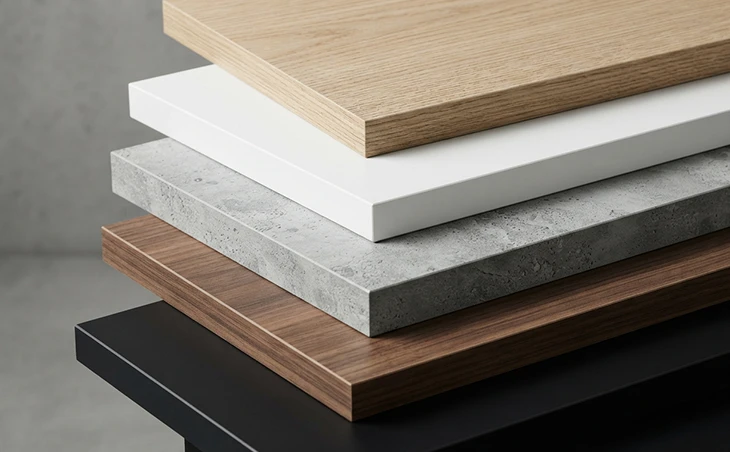
Every decorative panel you purchase is a two-part system: a decorative facing laminated onto a structural core. The facing dictates the aesthetic. The substrate dictates the panel's weight, screw-holding capacity, moisture behavior, edge quality, and ultimately your unit cost.
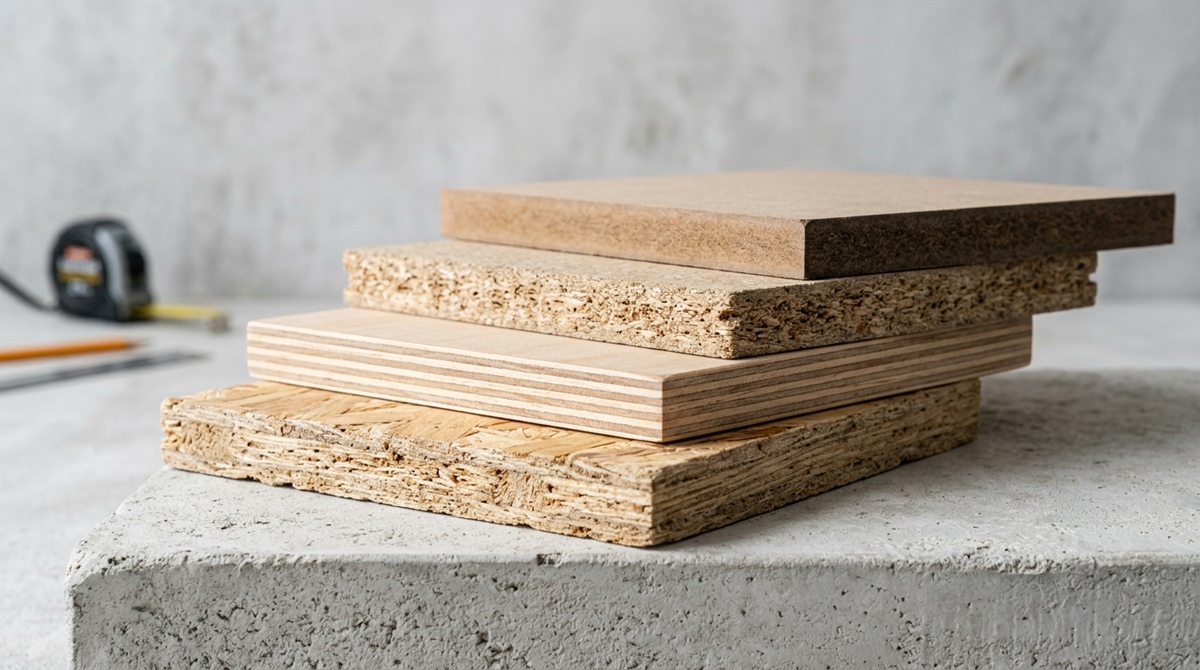
When you handle a warranty claim for a blown cabinet edge, a sagging shelf, or a pulled door hinge, you are rarely dealing with a facing failure. You are dealing with a substrate failure. This guide breaks down the technical realities of particle board vs mdf vs plywood and the role of fine-strand OSB, so you can specify the right core on your purchase orders.
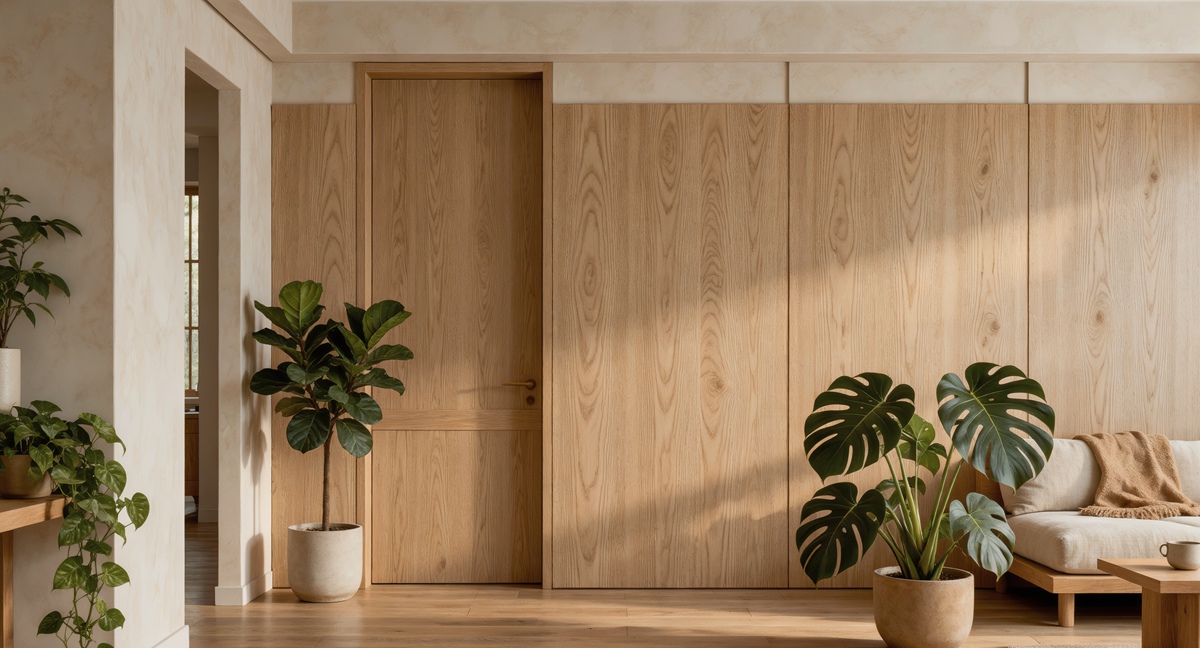
For many buyers asking what is mdf, the short answer is that it is the benchmark substrate for smooth, flat surfaces. The mdf meaning is in the process: hardwood and softwood chips are refined into fine, uniform wood fibers, mixed with wax and resin binder (traditionally urea-formaldehyde; MDI resins increasingly used for no-added-formaldehyde grades), and pressed under heat and pressure.
Density Range: Typically 700–800 kg/m³.
Edge Behavior: MDF delivers the tightest, cleanest machined edge of any engineered wood. Routed or cut, the core stays solid, with none of the porous voids that break edge banding adhesion.
Screw-Holding: Face screw-holding is adequate, but edges are vulnerable to splitting under repeated hinge or cam screw loading. Industry-standard practice is threaded inserts or confirmat screws rather than standard wood screws.
Moisture Resistance: Plain MDF swells irreversibly if soaked. Moisture-resistant (MR) grades delay swelling in high-humidity environments but are not waterproof against standing water.
Cost & Market Position: Middle of the matrix — more than particle board, less than plywood.
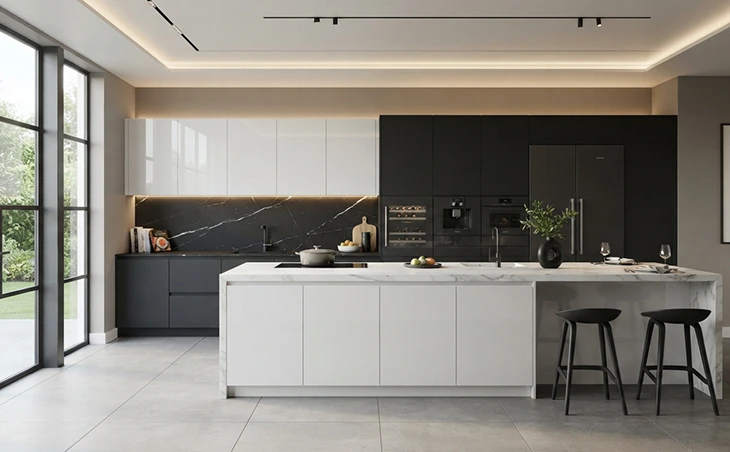
Best For: Smooth, perfectly flat slab doors. On high-gloss or super-matte PET laminated panels, MDF is the dominant core: its fine fiber structure prevents telegraphing through the thin film.
When comparing mdf board vs chipboard, the distinction is wood geometry. Chipboard particle board is made from wood flakes, shavings, and sawdust. Furniture-grade board uses a graduated structure: a coarse core of larger flakes for strength and stability, between fine-particle outer layers that give the lamination a smooth bed.
Density Range: Typically 600–700 kg/m³.
Screw-Holding: With correctly sized hardware, a good particle board performs well in flat-pack RTA furniture. Fasteners strip if over-tightened, and re-driving screws into the same hole is unreliable.
Edge Behavior: The coarse core leaves a porous cut edge. With thin banding tape or too little glue, the edge texture telegraphs through or the banding peels.
Moisture Resistance: Low. MR grades exist (often dyed green for identification), but standard board swells rapidly on water contact.
Cost & Market Position: The most economical substrate on the export market.
Best For: Budget flat-pack carcasses, wardrobe boxes, and melamine-faced panels for rental or commercial projects.
What is plywood in a furniture context? A structural panel of thin wood veneers glued with the grain of adjacent layers rotated up to 90 degrees. In Chinese export panels, core species are typically poplar, eucalyptus, or birch, depending on density and price point.
Density Range: Typically 550–700 kg/m³, heavily species-dependent.
Screw-Holding: The best of the four. The cross-laminated structure grips threads tightly, and screws can be removed and re-driven with minimal loss of holding power.
Edge Behavior: Cut edges show veneer layers and small voids, so plywood usually needs thicker edge banding (1.5–2mm) to present a smooth side profile.
Moisture Resistance: The most moisture-tolerant of the four. It will degrade if submerged, but handles high ambient humidity and occasional splashes far better than fiber or particle boards.
Cost & Market Position: The most expensive standard substrate, with prices varying widely by core species and veneer grade. On a particle board vs plywood comparison, the price gap can run 40–80% per sheet depending on species and grade — which is why most export carcass programs reserve plywood for wet zones rather than using it throughout.
Best For: Kitchen sink bases, bathroom vanities, and premium cabinetry in high-humidity markets.
The query osb vs plywood has massive search volume, but OSB (Oriented Strand Board) serves two different industries. Comparing plywood vs osb for a roof is not the same as comparing them for a wardrobe.
Engineered for construction — wall sheathing, subfloors, roofing — from large wood strands bonded with MDI or phenolic resins. In the construction debate, OSB is cheaper per sheet and uniform with no core voids, but if it gets wet during framing it dries far slower than plywood and swells permanently at the edges. Plywood is stiffer and holds edge fasteners better. Structural OSB straight from a lumber yard is rough and uncalibrated, and must never be used as a furniture substrate.
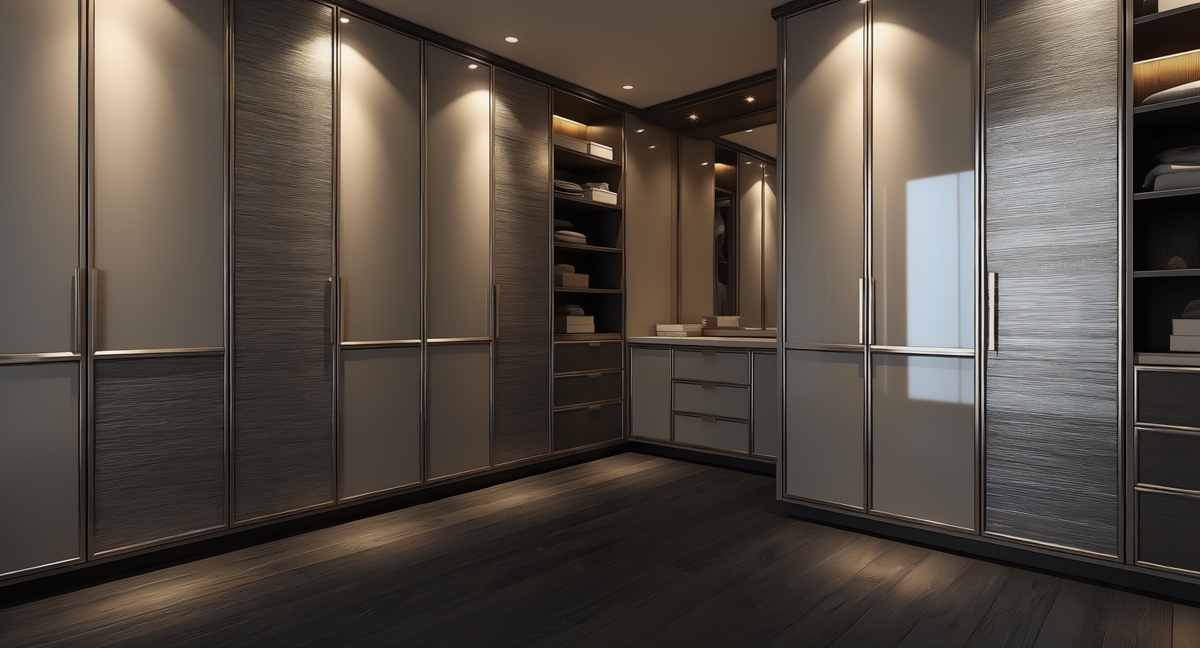
A refined product engineered for the cabinetry industry: fine-strand, homogeneous oriented strands, MDI-bonded, calibrated and sanded to tight thickness tolerances, then laminated with melamine or veneer.
Density Range: Typically 600–720 kg/m³.
Mechanical Strength: High bending strength and internal bond, with typical MOE values of 3000–6000 MPa — above particle board (1800–2500 MPa) and MDF (2200–3500 MPa).
Screw-Holding: Face screw-holding is exceptionally strong thanks to the interlocking strands; edge fasteners still need correctly sized cam locks or dowels.
Emissions & Moisture: Fine-strand furniture OSB is typically MDI-bonded. With no formaldehyde-based resin in the core, good FOSB routinely reaches E0 and ENF emission levels, and it offers good dimensional stability in humid environments. Properly calibrated FOSB edge-bands cleanly, especially with PUR adhesive.
Cost & Market Position: A premium carcass substrate in the Chinese custom-furniture industry — generally above particle board, around or slightly above MDF, below good plywood.
Best For: Premium eco-positioned wardrobe and cabinet carcasses, wall paneling, and exposed-strand design pieces.
|
Attribute |
MDF |
Particle Board |
Plywood |
Furniture OSB (FOSB) |
Structural OSB |
|
Typical Density |
700–800 kg/m³ |
600–700 kg/m³ |
550–700 kg/m³ |
600–720 kg/m³ |
~600–650 kg/m³ |
|
Screw-Holding |
Weak on edges; face OK |
Fair; strips if over-tightened |
Excellent; re-drivable |
Very strong face; fair edge |
Strong face |
|
Edge Quality |
Excellent; tight and smooth |
Porous; needs good sealing |
Shows layers; needs thick band |
Solid with calibrated edge |
Rough; not for banding |
|
Moisture Tolerance |
Poor; swells irreversibly |
Poor; degrades rapidly |
Very good; dries well |
Good; highly stable |
Fair; edge-swells if soaked |
|
Weight |
Heaviest |
Lightest |
Light to medium |
Medium |
Medium |
|
Machining |
Excellent for deep routing |
Cuts flat; chips easily |
Cuts flat; splinters possible |
Cuts flat |
Rough cuts |
|
Emission Options |
E1, E0, CARB2, ENF, F☆☆☆☆ |
E1, E0, CARB2, ENF, F☆☆☆☆ |
E1, E0, CARB2, ENF, F☆☆☆☆ |
Typically E0/ENF (MDI) |
Varies (MDI/phenolic) |
|
Typical Furniture Use |
High-gloss slab doors, routing |
Budget carcasses, flat-pack |
Kitchen/bath, premium boxes |
Premium carcasses, wardrobes |
None (construction only) |
|
Relative Cost |
Medium |
Lowest |
Highest |
Medium-high |
Low (irrelevant here) |
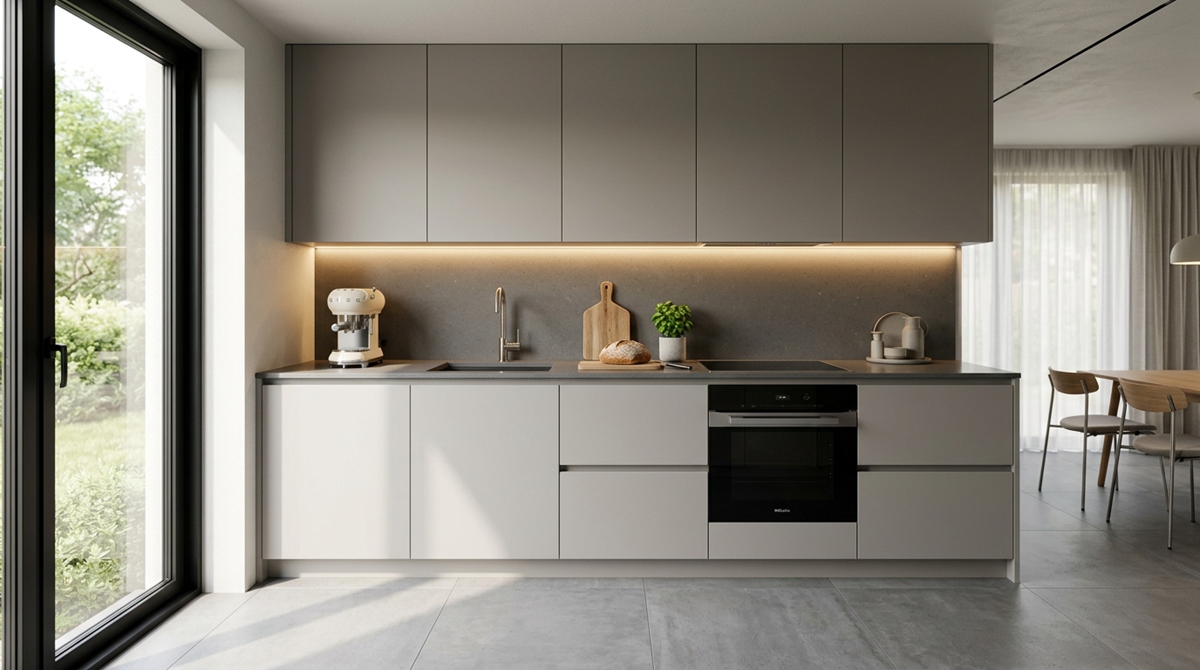
High-Gloss & Super-Matte Slab Doors → MDF. These finishes depend on a perfectly flat surface; any underlying texture shows as a visual ripple under showroom lighting. Even fine-strand OSB has a strand pattern that can telegraph through thin films, which is why high-gloss PET doors remain MDF-dominated.
Budget Flat-Pack & Standard Carcasses → Particle Board. For standard melamine board (TFL) cabinet boxes and rental projects, a quality 650 kg/m³ particle board gives the best ROI.
Premium Eco-Cabinets & Wardrobes → Fine-Strand OSB (FOSB). For markets demanding ENF or no-added-formaldehyde certification, FOSB with PUR edge banding has become a standard premium carcass option alongside plywood.
Kitchen/Bathroom Carcasses → Plywood. For frequent water exposure or very high humidity, plywood remains the safest bet. Its limitation: veneer layers can lightly telegraph through thin, solid-color facings over time.
Wall Paneling / Slat Backgrounds → MDF or Particle Board. These applications carry almost no hardware load, so choice follows your budget and emission requirements.
A PO that says "18mm White Melamine" is an invitation for substitution. Lock the variables down explicitly:
Specify type and emission grade: e.g. "E0/ENF MDF, 18mm" or "ENF MDI fine-strand faced OSB, 18mm". Emission grades (US EPA TSCA Title VI, CARB Phase 2, China GB/T 39600 ENF) apply to the substrate itself — verify the raw board supplier's certificates, not just your lamination factory's claims.
State density tolerance: e.g. "particle board, density 650–680 kg/m³". A 50 kg/m³ drop cuts raw material cost but ruins screw-holding.
Require MR-grade documentation: for moisture-resistant boards, ask for internal bond strength after a boil test — not just the green dye.
Dictate edge banding glue: specify EVA hot melt or PUR (polyurethane). PUR is the standard recommendation for kitchen and bathroom orders, and for properly sealing calibrated FOSB edges.
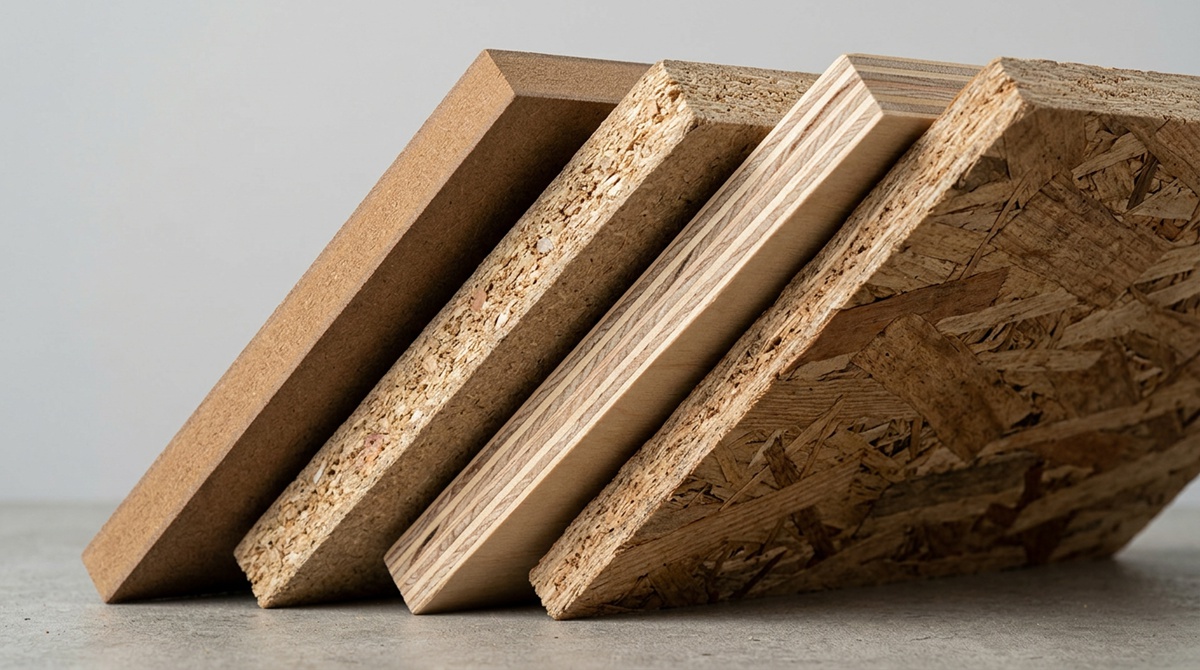
QC the cut edges: at pre-shipment inspection, photograph freshly cut edges. Look for core voids in plywood, oversized flakes in particle board, and poor calibration in OSB.
There is no "best" substrate — only the right engineering choice for your price point and market. Comparing osb vs particle board or mdf vs particle board in a vacuum ignores reality: a cheap, low-density MDF from a budget mill strips screws and fails faster than a tightly compressed premium particle board. All wood-based panels move with humidity; plywood is expensive and its layers can telegraph through light facings; standard MDF swells if edge banding fails near a sink; and structural OSB and furniture FOSB are entirely different products sharing an acronym. Match the core to the cabinet, and you stop paying for performance you don't need.
Looking to source stable, high-performance decorative panels? Foshan Panels New Materials (Noxseth) applies premium PET and melamine facings to strictly graded MDF, particle board, and FOSB cores. Contact our export team to discuss substrate options for your next order.